Showing posts with label china. Show all posts

Friday, June 24, 2016

Naadam: Our Final Festival

One of the best things about not living in a larger Chinese city like Beijing, Shanghai, or even Hangzhou is the presence of other cultures. In many parts of the country, the traditional Han Chinese culture is dominant and other cultures (Tibetan and Uyghur in particular) are many times discouraged and swept under the carpet. However, here in Bayannur somehow the Han culture and the Mongolian culture have managed to work together to create a very unique culture all its own that compliments one another.

During our May Holiday trip to Hohhot we got our first taste of Mongolian culture and today, we got our second taste with the Mongolian Student Association holding their very own Naadam Festival.

Naadam (Наадам in Mongolian and Naɣadum in Traditional Mongolian) literally means "games." It is an Eastern version of the Olympics and has three different events (which is why it is sometimes called "эрийн гурван наадам" or "the three games of men")--wrestling, archery, and horseback riding. Traditionally (just like the Olympics), this festival is reserved only for men, however, in recent years, women have begun to take part in both archery and horseback riding all throughout Mongolia. 


The largest festival, known as the National Naadam, is held in the capitol of Mongolia, Ulaanbaatar (ᠤᠯᠠᠭᠠᠨᠪᠠᠭᠠᠲᠤᠷ), from July 11-13. It is believed that the Naadam Festival has roots that date back thousands of years in one way or another--once connected to celebrations such as births and weddings as well as a way to train soldiers. However, today it is the official celebration of the 1921 Revolution where Mongolia declared its independence from China. 

Mongolia is just north of China and south of Russia
Supposedly, Genghis Khan's nine horse tails are still brought ceremoniously to the National Stadium for the opening ceremony. The nine horse tails are meant to represent the nine Mongol tribes. Of course, no one knows where Genghis Khan is buried so I'm not so sure where they found his horses...

Genghis Khan... Father of all Mongols.
The first event for the Naadam games is wrestling and it's only open for men to participate. Mongolian wrestling is different from other types of wrestling like those found in Japan and America. It is untimed and the only rule is that (other than your hands and feet) no part of your body can touch the ground. There are various rounds with one winner and one loser in each round. The wrestlers wear a two piece outfit--a tight shoulder vest called a "zodog" and shorts  called "shuudag." And each wrestler has an encourager or a "zasuul." They cheer on their wrestler and sing a song of praise and congratulations to the winner. 

You can see the zasuul as well as the tight shoulder vest and awkwardly short shorts.
The second event is archery and it is open for both men and women. Archery is a vital part of the Mongolian culture despite persecution in the past. The Mongols were some of the best archers in the world and even still today. The competition is split into teams of ten where men shoot from 75m away and women from 65m away. Unlike our traditional ideas of what archery tournaments look like (thank you, Robin Hood), Mongolian archery tournaments are very different. They have many different targets called "surs." The surs are woven or wooden cylinders and they are stacked three high. The goal is to knock out as many surs from the different stacks as possible in the round your team shoots. The goal is to hit 33. If there is a good hit, the judge will yell out "Uuhai!" which means "Hooray!" The winners of this game are given the title of National Marksman/Markswoman.

Women have finally begun to take part in the Naadam Festival as of 2005.
The third and final event is a bit different from the other two. It is open to both men and women but it is only open to those between the ages of 5-13 years! Just like archery, horses have been an integral part of Mongolian history and culture and that is clear even in the Naadam Festival. Just like archery tournaments, horse races in Mongolia are very different from those in America. In America, races are generally short (maybe 2km) and held within an enclosed track. In Mongolia, it is more of a cross-country event rather than a sprint. The length of the race depends on the age of the horse (a younger horse may only race for ten miles and older horses might go for seventeen miles). The child who wins the race is given the title "tumny ekh" or the "leader of ten thousand."

The little jockeys.
Now when I was first looking up things for Adam and me to do in Inner Mongolia, my heart sank when I saw the dates for the Naadam Festival, knowing full well that we'd already be back in America at this point. However, today we got a surprise message telling us that the Mongolian students at HeTao College were holding their own games before everyone goes home for the summer. We knew we wouldn't be able to get up to Ulaanbaatar so we were happy to go to the school's stadium and check it out.

At first, I felt bad--we were literally the only people there (I get the feeling that there is a big divide between the Chinese students and the Mongolian students here) but eventually more people came out to show their support. 

The Festival opened with a dance by a group of students dressed in beautiful traditional Mongolian dresses. Spinning around and even using dance moves to symbolize the ever important horses from their culture, it was a beautiful way to start the celebration of the Mongolian people and culture. 

The blue scarves in their hands are a Buddhist custom also seen in Tibet and even Nepal. However, instead of the traditional white, these scarves were blue. Blue is a very sacred color in Mongolian culture representing eternity as well as the sky so it would make sense their scarves would be blue. 
From there, four members of the Mongolian community, dressed in traditional clothing (called "deel"), made their way slowly around their very own ovoo (shrines scattered throughout the grasslands, usually made of stones, where people come to pray for rain). The four men walked around the ovoo three times, just as we were taught to do when we visited the grasslands. Each of them held one of the blue scarves as well as different plates of food. As usual, we had no idea what was going on, but I'm thinking it was some sort of offering given up to bless the games. After all, the Naadam games were once seen as a Buddhist celebration until influence from Communist Russia affected the games in the 1930s and made them much more secular.

The two very different ovoos--one in the grasslands and one in our stadium.
The men walking around the ovoo three times before offering up different plates of food.
Of course, our Naadam Festival did not have horseback riding as an event (no children, no horses, no cross-country). The majority of the festival was watching the young men wrestle one another. Some got really into it and others just let their opponent throw them over their shoulders within the first three seconds. They wore their "zodog" tight shoulder vests but, thankfully, the shorts were replaced with jeans and sweatpants. 


We were originally up in the stands but then one of the Mongolian teachers came up to us and brought us back down to the VIP seats right on the field. Nice!

I'll admit, archery was a bit lame. For how much history has built up the Mongols as these incredible archers, most of the guys shooting didn't even seem to know how to hold a bow! I guess times have changed... However, there was still a "sur" for them to shoot at and they drew back with their thumb as opposed to their pointer finger like we were taught out in the grasslands!

Let the foreigners show you how it's done! 

Descendants of the great Khans and Mongols!

Of course, our school's little Naadam Festival was nowhere close to what you would see at the National Festival. However, I'm really proud of the students who came together during finals week to celebrate their culture in a place where it's sometimes hard to be proud of who you are. I could see from the dancing to the wrestling to the smiles that they were having fun, being themselves, and sharing their proud Mongolian culture with us. 

*~*~*~*~*~*~*~*~*

Well, this is the last you'll hear from me for a little while. Tomorrow we are flying out of Bayannur and making our way to one of the happiest places on earth--Hong Kong Disneyland! A few days of magic and then it is back to the land of the free and the home of the brave. 

See you all in four days!!

Until Next Time,
Amanda

Wednesday, May 4, 2016

Gobi Desert Greetings

While the terrain down in the south of China where I've lived for years was very similar from place to place with the occasional mountain popping out on the horizon, the terrain here in Inner Mongolia is wild. You'll be in the middle of the plains for hours and suddenly there are mountains rising high above you only to be followed behind by a desert. That's why Adam and I were excited to find that the tour we had chosen took advantage of the varying terrain.

After spending the night drinking and laughing around a poop fire and sleeping in our yurt (seriously one of the coziest places I have ever slept!), we boarded our trusty bus and headed out of the grasslands, passed the big city, left the mountains in the dust, and stepped out in the Gobi Desert.

The Gobi Desert spans across both China and Mongolia. In Chinese it is referred to as 戈壁 (Gebi) and in Mongolian, it is Говь or "Gevi." The Gobi Desert is the fifth largest desert in the world and the largest one in Asia at 500,000 square miles. It is both sandy and rocky and it tends to be a very cold desert (I know! I assumed all deserts were hot too... until I was freezing in one!)

We were in the part of the desert called Ordos Desert. You can see the city of Hohhot to the northeast of us.
The Gobi Desert is the home of many different species despite the harsh climate including gazelles, Mongolian wild ass, and sometimes even snow leopards, wolves, and brown bears! And of course, a desert would be incomplete without camels. 

There are two species of camel in the world. The one humped dromedary camel, also known as the Arabian camel, is from (you guessed it!) the Arabian Peninsula and is found all through Northern Africa today.  The camels found in Inner Mongolia are known as Bactrian camels and are only found in small pockets in Central Asia. They are considered critically endangered in the wild and are almost entirely domesticated today. 

The Bactrian camel population VS. the Arabian camel population.

Now it's been a dream of mine ever since I was a little girl with hopes of being an Egyptologist to ride a camel through the desert. Fourteen years in the making, you can be darn sure I was going to get on the back of a camel while living in the middle of the Gobi Desert. 

After putting on unnecessary protective covers for our shoes, we hopped into a large (for lack of a better word), sand dune rover (it almost resembled those amphibian trucks that can enter into the water on those super touristy Duck Tours). The driver with no fear of hydroplaning (or the sandy equivalent), zoomed down the road and up and over the dunes. As we traveled further from our bus and deeper into the desert all vegetation seemed to vanish and nothing but golden rolling sand dunes surrounded us for as far as we could see. 


We arrived at a little oasis where we were greeted by our own little herd of camels. I was the first to hop up on a camel's back and I quickly dubbed him Clyde. 

Fun fact: when camels stand up with you on their back, it is terrifying. You lean forward and then fall back, all the while with this massive creature beneath you. But my heart quickly stopped pounding from fear and started beating for the incredible views I could see from Clyde's back. 

Cross off #103 from My Life List! 
Following behind in a perfect little line (except for Clyde who didn't like waiting his turn), we wandered through the desert. The wind was brutal and the sand got everywhere (seriously, I am still finding it, three showers later) but the relaxed amble of the camels and the wave-like patterns in the sand were incredible. 


I've always had a love for horses (I think many girls go through a stage in their younger years where they dream of owning a horse before they actually realize the cost behind it) but for some reason, I've found that my love for riding a camel runs far deeper than riding a horse (it could be that the horse's trot was merciless on my bottom and the camel's slow stroll pitied my bum). You can see why for thousands of years different people in different parts of the world have chosen the camel as their companion through the harshness of the desert. 


Being a girl from Buffalo, New York, I am very much familiar with sledding. I had my Pocahontas sled growing up that I would take down to the river with my mom and my brother. It was wet. It was cold. It was white. 

If you can sled down a hill in the snow, why not try it in the sand too?

Taking one of the super beat up, broken, and completely falling apart "sleds" one by one each of us conquered the dunes of the Gobi Desert. Standing at the very top, it's a bit intimidating. You see how steep the hill is. The wind beats at your back, threatening to push you over before you're ready. But you know how it goes--when in Rome! 


I only managed to slide down twice because once down, we had to climb back up the hill. It sounded easy but about halfway up, myself and a young French girl just turned and looked at each other and decided that right there on the dune was a perfect place to die. 

It's just incredible seeing sights like this--they belong in books or movies or your imagination. How can they be real? How can you touch them? Hear them? Smell them? As I push myself down the sand dune, I couldn't help but feel like Rey on Jakku from The Force Awakens (sorry for the major nerd out but it's true!). 

I can see the similarity.

While the grasslands were beautiful, it is the desert that I would demand that everyone gets to see at least once in their lifetime--to see that what is harsh can also be beautiful and life changing. 


Until Next Time,
Amanda

PS: Happy Hump Day!! See what I did there? ;)
55 days... 

Thursday, April 7, 2016

DIY: The Expat Edition

For anyone who has lived abroad for at least a year, you know full well that desperate times call for desperate measures. And sometimes, it takes a lot to get used to your new surroundings--new language, new cultures, new fads, and new no-nos. In America, it might be safe to drink tap water but in other parts of the world, you might as well sign your own death sentence. Here in Bayannur, we wash our clothes by hand and we have to wait for the sun to heat up the water for our showers (that took us way too long to figure out!).


The life of a traveler is filled with adapting to new cultures... but there are some things that I find I just CANNOT give up, no matter how many places I've traveled or how hard I try to assimilate into the culture I live in.


Most times, you cannot easily find the things you love, celebrate, or crave... so it's up to you to get your hands dirty, get a little creative, and do it yourself!


Holidays


Holidays are always the toughest to try and celebrate when you're living in a country so different from your home. China is a perfect example. Staple holidays like Christmas, Thanksgiving, and Halloween do not exist over here and if it does, that's because tenacious expats make sure to find ways to celebrate.


Thanksgiving is easy enough to work with--you might have to eat chicken instead of turkey. One year I made chicken wing dip but couldn't find bleu cheese dressing so I had to go with "yoghurt dressing" whatever the hell that means. It turned out okay to the untrained laymen but Adam and I could taste the difference and it was unacceptable.
Those roots are unacceptable too...
 Christmas is pretty popular in China. As a matter of fact, some stores are STILL decorated. The only aspect of the holiday that I find a bit disappointing in the fact that it somehow hasn't made it's way over to China is the elusive pickle! It's a German tradition and one that my family has always celebrated. I won't go into the fact that for almost two decades Jed would destroy me... I don't think I ever actually found the pickle.
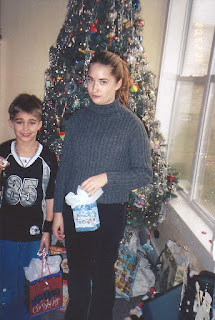
Back when I was actually taller than Jed. Moody teenage Amanda with her itty bitty prize and adorably awkward Jed with the pickle and his stupid big prize.
For those of you unfortunate souls who are neither German nor celebrate Christmas with the pickle, let me explain. Traditionally, the glass pickle is the last ornament to go on the Christmas tree and the child who is the first to find it gets an extra gift on Christmas Eve. Today, kids strangle and wrestle one another to try and get to the tree first. I've done this all my life and not once have I succeeded.


In China, it's a bit difficult to find a glass ornament in the shape of a pickle (shocking, I know!). So, one Christmas, while in China, Adam and I decided to improvise. Instead of a pickle we used a pepper... a real pepper.


It's Halloween that's the tough one to still find a way to celebrate, no matter where you are. Halloween is a sacred holiday for me, and so, no matter where I am--China or Russia it would seem--I find a way to celebrate.


In China, I managed to carve a jack-o-lantern out of a watermelon (you can read more about that here) and somehow it actually turned out awesome! That same year, I was able to introduce the art of pumpkin (watermelon) carving to my students at an English corner. They were able to realize just how much they were missing out in the glorious month of October.


It was interesting to find in Russia, too, Halloween is not nearly as popular (or at all) as in America. Actually, Putin has tried to outlaw public displays of Halloween frivolity in big cities such as Moscow and St. Petersburg because he sees it as a negative Western influence, particularly coming from America. However, Novosibirsk is far away (I mean FAR away) from Moscow and so Halloween is a bit more accepted in the city. We actually had some Halloween parties with students and some teachers even dressed up.

Luckily for me, I was off on Halloween and had all day to celebrate. But once again, it was impossible to find pumpkins to carve! It was like China all over again. Instead of watermelons, we decided to actually buy gourds and carve them into jack-o-lanterns. I think there's a reason why pumpkins were chosen for carving (contrary to what you might think when you're trying desperately to carve a circle into a pumpkin)--they're easy to work with! At least easier than the evil gourds we picked.


FOOD

Now, a good traveler is one who is always brave and willing to try new foods and be content with eating the foods of the country they are visiting or residing in whether it's rice and noodles or cabbage and vodka. However, being content with what your specific country has to offer you can only last for so long and eventually the cravings begin to set in. Usually this is once the "wonderment" phase of culture shock passes and you suddenly realize you have absolutely no access to good beer, huge hunks of meat, or cheese. It's about one month in that rice, noodles, and vegetables just aren't good enough anymore and these cravings usually start. And it is at this time that--in order to survive--you must take matters into your own hands.

I've found that DIY food projects can either turn out really good or really really bad.

The Good: Chicken wings

For my 24th birthday, instead of going out to a fancy restaurant in Hangzhou, I wanted to attempt #139 from My Life List (you can read all about our kitchen escapades right here). And so with a bottle of Frank's and 25 chicken wings from the wet market, we attempted and--I'm proud to say--succeeded in making chicken wings that were good enough to appease this Buffalo girl.


The Bad: Mulled Wine


For every success in the DIY expat collection, there has to be an utter failure and that would be our attempt at hot mulled wine for Christmas 2013. We figured we had cinnamon sticks, an orange, and come cloves--why not throw it in and heat up some of our leftover Chinese red wine? SUGAR. No one told us to add sugar. So, no surprise, it was terrible. We've gotten better at it! But I suppose we had nowhere to go but up.


We've done a few other DIYs over the years. Christmas ornaments, attempts at making bacon only to realize you bought pork organs and not pork, baking brownies from hot chocolate packets when you don't have cocoa powder, making olive brine by adding saltwater to your olives for the perfect martini, and building furniture out of scraps of wood you find lying against the garbage shoot (this totally worked but sadly we have no photos which is a shame!).


This past week, we've continued on in the DIY tradition by successfully making two things of food (you can clearly see that most of this post is about food... mainly because I'm hungry at the moment): homemade jiaozi 饺子 (basically dumplings you can boil, steam, or fry) and cheese!


Jiaozi 饺子:


I am a big fan of jiaozi. Ever since moving to China, they are some of my go to meals. In Hangzhou, they were usually beef or pork but here in Bayannur, most of them are mutton (Yang Rou 羊肉). Around here, they seem to be steamed usually which is fine but sometimes you just want something unhealthy and fried... and that's just what we did.


Taking what little mutton we had left from our Easter celebrations, we marinated it with the few spices we've come to recognize over here and I set to work on making the wonton wrappers. In America, you can find these bad boys at any Asian market. Around here? Not so much. Homemade from scratch it is!


All you really need for this is water, salt, and egg mixed nicely together before pouring it into the middle of a bowl of flour and some more water before you mix, mix, mix until it creates a nice dough ball. Wrap it and let it sit for 30 minutes. Once you've let it settle, it's time to bust out the rolling pin. Sadly, we didn't have a rolling pin or a wooden dowel so I improvised and used a wine bottle (I swear I'm not an alcoholic). It's a bit tough getting the dough as thin as it needs to be and after you're covered in flour and your hands are aching, you understand why you go out and buy these premade in America.


While I continued to roll and cut the dough into thin 3x3 squares, Adam began to fill them with our delicious mutton and eggs cooked in the mutton fat (trust me, it was more fat than meat). In the end, we had almost 30 dumplings to either steam or fry.


Since this was my master plan (at least in my head I knew it could work), I was in charge of cooking these little guys. Now, I'm the first to admit that I'm not the best chef in the world. Sure, I make a mean stuffed banana pepper soup but it's one thing going from a recipe and making stuff up as you go and hoping that it will all work out in the end. This had been hours of prepping, rolling, and stuffing... I couldn't mess it up now! No pressure...


Ignore our nasty little kitchen...


If the smell was any indication, things turned out better than I anticipated.


Low and behold! Our steamed and fried jiaozi turned out great (though they do kind of look like little turds) and they tasted even better.


Our first DIY of Bayannur was a huge success! But, I was determined to try something a bit harder and something I craved even more.

CHEESE

Cheese is just one of those things that you either love it or you hate it and I have a passionate love affair with it. The biggest downside of living in China (apart from being so far away from family) is the total and complete lack of cheese. I assumed that Bayannur might be a bit different from Hangzhou--dairy is actually a big part of life here in Inner Mongolia. You can find milk and yoghurt at every store you walk into but for some reason, cheese is still a myth over here.

So when I found cheesecloth at the night market, you can be darn sure I found a challenge on my hands.

Now cheese is hard because many of them require bacteria cultures which even if I could find over here I doubt I would dare use it in my food. But luckily, I found a recipe for Farmer's Cheese with just three ingredients: milk, white vinegar, and sea salt.


For anyone interested in trying this on your own, here's how we did it!


Pour one gallon of milk into a pot. It should not be super pasteurized and the pot should have a nice thick bottom. Sadly, we had to buy 15 little boxes of milk to get to a gallon... it should be easier in America!


Over medium heat, bring the milk to a boil. This takes a bit of time... It will start curdling on top so you should keep stirring it pretty frequently so it doesn't burn to the bottom. I thought I was stirring it enough but at the end I saw I had scorched it pretty bad.


As soon as the milk starts to boil, reduce the heat to low and add 1/2 cup of white vinegar. Almost immediately, the milk should start separating into curds and whey (I had no idea it was a greenish blue! Little Miss Muffet what is wrong with you?!?). If it doesn't, keep adding vinegar, one tablespoon at a time. It will be obvious when it starts working.


I'm not going to lie, I kind of lost it at this point. I started jumping up and down and shouting, "SCIENCE!" over and over again as the curds continued to form.


My SCIENCE! face.
At this point, the science part is done. Take your cheesecloth and line a colander with it and begin to scoop the curds out of the pot and into the cheese cloth. This kind of cheese is very crumbly and is in little pieces so make sure to get it all. You'll be surprised by how much cheese this actually makes!


 Once all of the curds are in the cheesecloth, rinse them with cold water to get rid of any of the extra whey. Once they're nice and clean, sprinkle the sea salt on top. The recipe I used said two teaspoons, however, this cheese is pretty bland so I would recommend more (I'm even thinking of adding garlic or onions or little peppers the next time I try this). Once the curds are salted. tie the cheese cloth, squeeze it tight to get rid of any more whey and excess water and then you should find a nice place to hang it up! It is still a bit wet so we hung it up over our sink so if it dripped it wouldn't make a mess.


After two hours of impatiently waiting, we nervously opened up the cheese cloth and voila! Our very first attempt at cheese!


And this cheese is good for up to about a week!


I was surprised by how easy this was and how well it turned out on our first try. So far we're two for two in the DIY attempts here in Bayannur. I know sooner or later we're bound to fail miserably but for now I will happily eat my jiaozi and cheese and continue counting down the 82 days until I am drowning in good beer, burgers, wings, and cheese... so much cheese.


Until Next Time,
Amanda